A masterplan to reconnect the town’s centre, communities, transport hubs and visitor destinations.
Surrounding Pontefract’s town centre is an area comprising of eight underused, unattractive sites. These disconnect the c30,000 residents from their historic town centre. Pontefract has one of England’s most important castles and one of Europe’s oldest horse race venues.

Pontefract has all the ingredients it needs to be a successful, busy and thriving market town which blends history with the modern requirements of the 21st century. Working together, our masterplan helps to make the most of these individual elements and create a place that the people of Pontefract can be proud of.
We were appointed by Wakefield Metropolitan District Council, through a competitive process, to propose a strategy for transforming these areas and reconnecting the town centre with its communities, transport hubs and visitor destinations through a masterplan.
Regenerating these eight areas will provide new homes, business premises, and community facilities. This will underpin a sustainable future and the vitality of Pontefract’s High Street.

Understanding Pontefract’s Masterplan
Whilst the town centre has some notable strengths, its challenges are many and varied. A poor sense of arrival, the proximity of public transport, pedestrian connections with surrounding neighbourhoods, space for smart growth, and lack of space for young people all hold back the success of the town centre. Pontefract’s vision is to embrace its historic core and the areas fringing this. The masterplan does this by:
- Contributing positively to the existing character and identity of Pontefract.
- Enabling active travel, walking and cycling, and supporting use of public transport.
- Providing space for enterprise, start up and scaling up, cultural and community uses.
- Creating an attractive, high quality, sustainable town centre living offer.
- Incorporating and safeguarding nature.
- Increasing the amount of green space, trees, sustainable drainage and play provision, and
- Minimising resource consumption, using renewable sources of energy and integrating drainage with green infrastructure.

Working together
An extensive study of the wider context included gathering and interpreting data, conducting field studies and engaging with local residents and businesses through workshops, surveys and exhibitions. This helped us understand the role, issues and aspirations for the town’s wider area and the feedback gathered informed initial proposals for each intervention area. Together with the community, these ideas were explored in conversation at workshops (partly online due to COVID restrictions) and shaped the overall masterplan. The proposals for the eight areas were considered jointly, and the overall masterplan includes a balance of uses, activities and homes across the town.

Importance of Horsefair
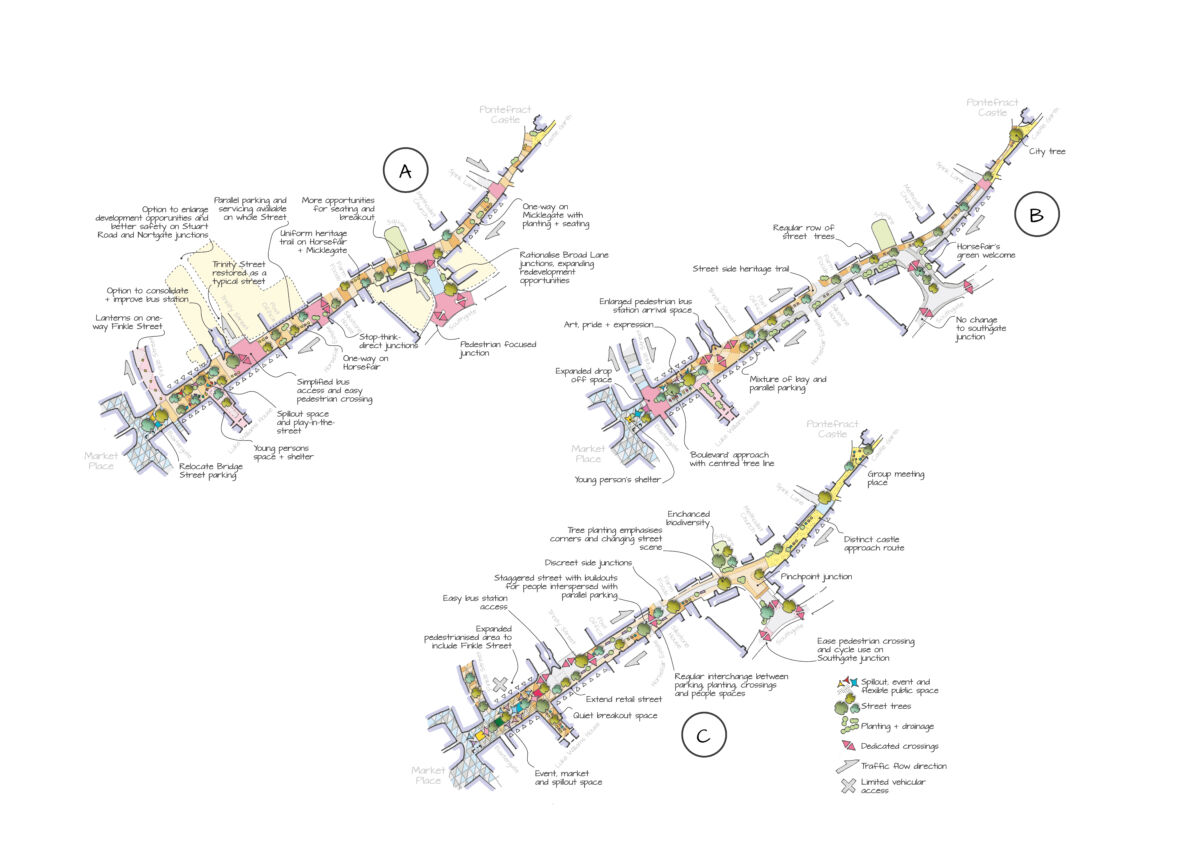
One of the principal link routes for both pedestrians and vehicles close to Pontefract town centre – ‘Horserfair’ – had been identified in a previous study as a main intervention area. In parallel to this masterplanning exercise, we were commissioned to undertake a feasibility study in a ‘Streets for People’ project which focuses on improving Horsefair and strengthening the link between the castle and the town centre for pedestrians.
This project presents options in line with 12 Streets for People indicators, measured using the 31 metrics for a public realm improvement scheme that will be delivered by Wakefield Council. The final Streets for People project proposals will act as a catalyst for the main masterplan.

Responding to the Climate Emergency
A key driver for the masterplan has also been the Council’s declaration of a Climate Emergency. The masterplan for Pontefract brings forward the objectives, strategy and policies of the adopted Wakefield Local Plan and the emerging Wakefield Local Plan 2036. The accompanying guidance and design code are important to achieving a sustainable and successful town centre. Growth of the local economy, improving quality of life and wellbeing and expanding the town centre as an attractive focal point for the community are embedded in the masterplan. Flexibility in the masterplan enables the design process for individual sites or areas to respond creatively.
Communicating design intentions
The design code sets out 25 headings; these give guidance and priorities for future developers to better benchmark, respond and understand the intent for delivering development. Drawing on the knowledge within the guide and the tools within the code will enable better, beautiful, and high quality proposals to be brought forward.

Ensuring deliverable next steps
Our final masterplan focuses on strategic elements including land uses, movement, urban design and green infrastructure, as well as guidance on viability, phasing and delivery. The masterplan itself has a vital role to play in the delivery process, setting out a future prospectus for the regeneration different component sites of central Pontefract. It provides a focus for partners to come together and work out in more detail the arrangements and funding to make things happen.
