BANES Council’s new ground-breaking energy-based net zero housing policy is great news for the climate, but what does it mean for local housebuilders?
Nash Partnership’s Planners and Architects came together to sift through the lengthy guidance behind the policy and work out the key implications for our clients.
The policy applies to planning applications that are determined following adoption of the Local Plan Partial Update in January 2023, ie. it applies to current undetermined applications.
The aim is to achieve net zero operational emissions through reducing demand and increasing onsite renewable supply. The policy includes limits on space heating and total energy use, taking an energy-based approach, rather than being based on carbon reduction as per the Building Regulations.
For major residential development, where onsite renewables are not feasible or viable, carbon emissions must be offset by contributions to the BANES carbon offset fund.
Specifically, new build residential development, through an energy assessment, will have to meet the following standards:
- Space heating demand less than 30kWh/m2/annum;
- Total energy use less than 40kWh/m2/annum;
- On site renewable energy generation to match the total energy use, with a preference for roof-mounted solar PV;
- Connection to a low- or zero-carbon District Heating Network where available.
The good news is this means few gas boilers in new builds, cost-effective heating for new residents during a cost-of-living crisis and more rooftop PVs, reducing the need for greenfield renewables.
The challenges are in meeting those demands for future housing and also retrofitting existing housing and historic buildings to reduce energy consumption. Our Director of Design Kevin Balch is a re-use and retrofit champion who’s particularly experienced in working with heritage buildings. Whether clients are looking to re-use a listed building or retrofit a more modern property – or something in between – Kevin understands all types of existing building, advising on aspects from standards and legal obligations to the most appropriate ways of reducing energy and the best solutions to help achieve that goal.
How do we meet these standards?
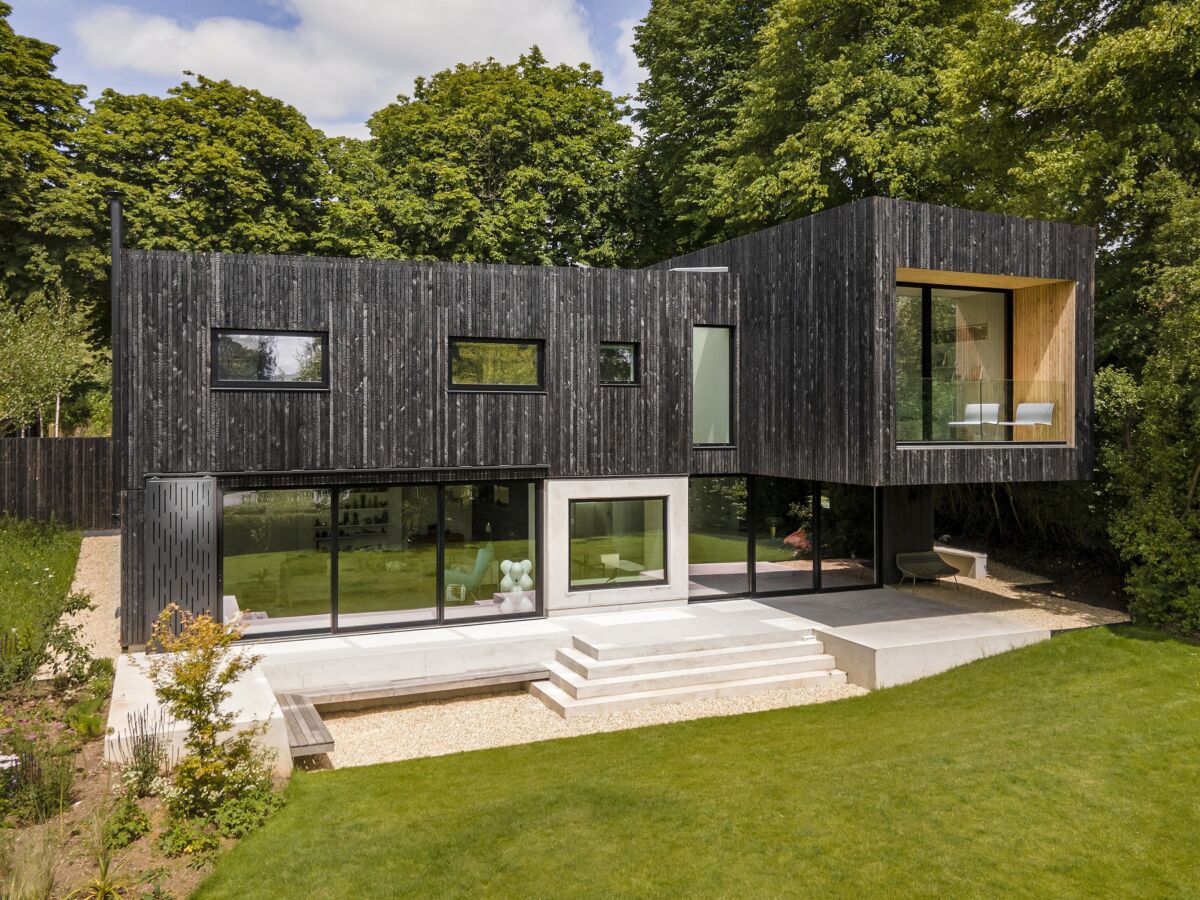
Nash Partnership’s Grove House project in Bath, completed in 2021, meets these tight standards. This innovative stylish timber-framed home built off-site with highly insulated air-tight timber panels boasts an Air Source Heat Pump with mechanical ventilation heat recovery used for heating/cooling and ventilation. It also has PV panels and battery storage for electricity generation.
What does this mean for a current project?
The new targets are a significant leap in terms of U values (thermal resistance) than those required by the recently updated Part L Building Regulations. For a current Nash Partnership individual dwelling project, this means our architects will incorporate flat-roof Photo-Voltaics and a Mechanical Ventilation and Heat Recovery (MVHR) system into the design, while closely working with an energy consultant at the design stage. For the client, this has implications on the up-front build costs (which will be recouped over the long-term when set against energy costs), potential reductions in liveable space due to the need to incorporate a plant room into the design and important decisions to be made regarding construction methodology (eg. off-site pre-fabricated timber frame versus much thicker walls).
For development to achieve the new policy requirements it’s clear that good design, quality craftmanship, and expert contractors will be key.
For development beyond the individual home, there remain many questions including the implications on profitability, viability of affordable housing and whether it will impact on the deliverability of housing figures overall.
Are there other changes I need to know about in BANES?
Yes, several, including:
- Reduced parking standards for BANES eg. Bath city centre is now 0.5 spaces per dwelling.
- A need to provide EV charging for new builds with 1+ parking space or garage.
- Biodiversity Net Gain (BNG) – the minimum requirement for 10% for major development is now policy ahead of the national requirement which will be mandatory for larger developments in England from November 2023 (and small sites from April 2024). Minor development will only be permitted where no net loss and appropriate net gain is secured.
What about Bristol?
Bristol has committed to becoming carbon neutral and climate resilient by 2030 and the City Council has recently closed consultation on its Local Plan Review, which includes draft net zero policies. It is anticipated that the new local plan will be adopted in autumn 2024 but there will be a further opportunity to make representations later in 2023 once the results of the consultation have been taken into account and a publication version produced.
For operational carbon, the specific draft standards for development are:
- Achieve a maximum 15 kWh/m²/year space heating demand;
- Achieve the following standards:
- In the case of new homes and other forms of accommodation, a maximum energy use intensity of 35 kWh/m²/year;
- In the case of major non-residential development, the operational energy/ carbon requirements of BREEAM ‘Excellent’ rating; and
- Provide on-site renewable electricity generation with an output equivalent to at least the annual energy consumption of the development, as calculated using an operational energy model.
For embodied carbon, the general principle is to minimise embodied carbon (the greenhouse gases emitted during construction including from extraction and processing of materials used, their transport, installation, maintenance and end-of-life disposal). Development will be required to demonstrate how this is achieved through a Sustainability Statement. Major applications will be required to undertake an embodied carbon assessment.
New development will be expected to achieve the following targets as a minimum:
- Residential (4 storeys or fewer) – <625 kgCO2e/m2
- Residential (5 storeys or greater) – <800 kgCO2e/m2
- Major non-residential schemes – <970 kgCO2e/m2
Shortfalls will be offset through financial contributions or other energy efficiency schemes in Bristol.
And other councils?
In light of the emphasis on climate change in the Government’s Environmental Improvement Plan 2023 and the proposed changes to the National Planning Policy Framework, other local authorities will follow suit. For example, Cornwall Council formally adopted its Climate Emergency Development Plan Document on 21 February 2023.
Need to know more?
Come and talk to us!